
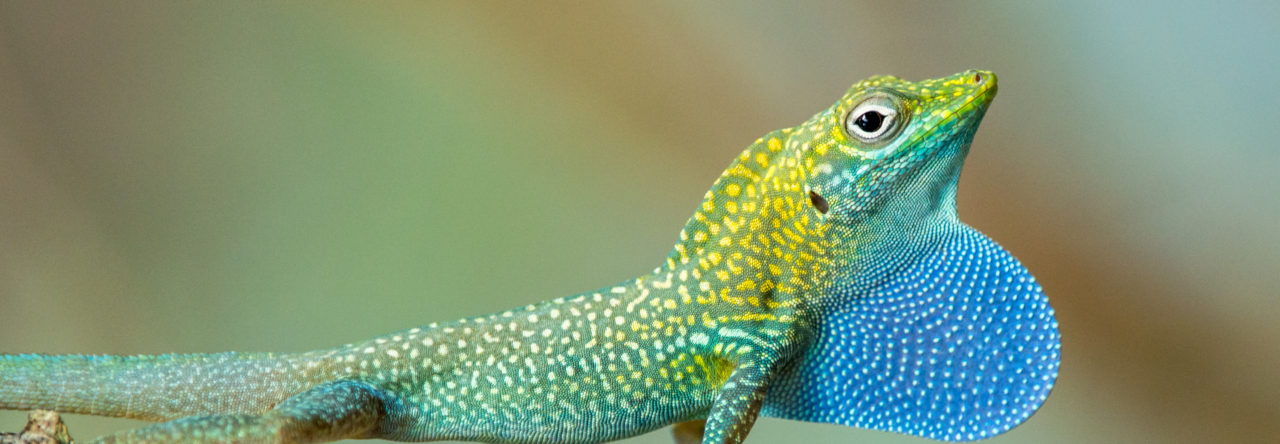
Spring Time and the Green Anoles Are Back in Georgia

From the pages of Vanguard, the student newspaper of the University of North Georgia:

The Green Anole is Back in Georgia

Despite being misunderstood, Green Anoles remain adaptable and present in North Georgia. Photo by Riley Hansen.

Despite being misunderstood, Green Anoles remain adaptable and present in North Georgia. Photo by Riley Hansen.

With spring weather on the rise, green anoles, a small lizard species native to the southern portion of the United States, are returning to Georgia in large numbers.  Anolis Carolinensis is known as a “trunk-crown ecomorph,” meaning they can change colors from shades of brown and green depending on their temperature and stress level.

Lily Grace Smith, a UNG freshman with a concentration in sustainability, said, “I have experience with green anoles because they like to hide in my house a lot.  I live near a creek in a forested area, so I come into contact with them frequently.  They are seen as scary because they like to jump around a lot to try to escape, but if you hold them by softly holding right under their head, you can release them.

Lily Grace Smith, a  holding a green anole she caught.  Photo by Lily Grace Smith.

The Green Anole also faces many challenges through deforestation and predation.  Green anoles originally inhabited the low-level brush of forests and gardens but were pushed into the higher topiary region by their invasive neighboring species, the brown anole, a non-native species native to the Caribbean that was introduced in the late 1800s.

“I’m glad I’m seeing them around because they regulate the insect population and also keep their predators around,” Smith said. “I wish people would save them and, if possible, make tiny habitats for them (keeping leaf litter, brushes, vertical spaces for them to bask on).” – Lily Grace Smith, UNG Freshmen Environmental Spatial Analysis Major

With limited research on the specific predators impacting the green anole populations, researchers are studying specific instances of predation that have appeared due to the introduction of other non-native species such as carnivorous plants.

In a publication from Herpetological Review,  authors Daniel A. Warner and Patrick Thompson of Auburn University said, “Although Interactions between these two species are probably rare, the native ranges of ‘A. carolinensis and D. muscipula overlap in areas of North Carolina and South Carolina, USA, suggesting that A. carolinensis is a potential source of nutrients for this carnivorous plant.  In addition, the small size of the D. muscipula restricts prey to relatively small individuals, and its small native range restricts the impact of this predator to a limited area.”

Despite these challenges, the green anoles’ adaptability and rapid evolution have assured their return to houses, schools and communities of the south this spring.


Anole Chocolate to Save Nature!

Mashpi Chocolate sustainability farms chocolate to help preserve nature in Ecuador. And anoles are doing their part. As they say on their website: “All the ingredients we use in Mashpi Chocolate are grown in an agroecological and regenerative way, next to cocoa trees and within edible forests….We created this chocolate to preserve a native forest reserve, restore degraded areas and generate opportunities in the magical territory of the Andean Chocó….The beauty of coffee is that it is planted under the shade of other trees, providing a habitat for many other species. We use high-altitude coffee as it has a special set of aromas and a characteristic taste that makes me want more!”

As for anoles, decide for yourself which species! Perhaps the fabulous Reptiles of Ecuador‘s Anolis webpage can help!

And many thanks to the Missouri Botanical Garden’s Carmen Ulloa Ulloa for not only tipping AA off to this, but providing a delicious sample!

Dinámicas Evolutivas y de Diversificación en Regiones Montañosas Tropicales

Anolis heterodermus. ¡Esta especie andina puede vivir hasta 3700 metros sobre el nivel del mar! Foto por Jhan C. Salazar.

Al igual que cuando era estudiante de pregrado, me demoré un buen rato en decidir qué hacer para mi tesis doctoral, ya que tuve que replantear la mayor parte debido a la pandemia de COVID. Meses antes de mi propuesta, encontré un artículo muy interesante de alguien de mi ciudad natal (Cali), Julián A. Velasco (Velasco et al. 2020). En este trabajo, Velasco y sus colegas trataron de responder dos preguntas: primero, si el calor y la disponibilidad de alimento explican por qué el tamaño de los animales varía geográficamente; y segundo, qué tan rápido cambiaron esos tamaños a medida que el planeta se enfriaba durante los últimos 66 millones de años. Para esto, utilizaron una base de datos masiva con información georreferenciada de 379 especies de Anolis.

Cuando llegó el momento de escribir y presentar mi propuesta en 2021, uno de mis capítulos se basaba en los datos de Julián. Sin embargo, no conocía a Julián en ese momento, ni tenía la base de datos original de casi 25,000 individuos georreferenciados. Por suerte, al año siguiente, 2022, se llevó a cabo el Congreso Colombiano de Herpetología en mi alma mater en Cali, la Universidad Icesi, y Julián era conferencista invitado. Así que le envié un correo electrónico unos meses antes del congreso para agendar una reunión y discutir el proyecto que tenía en mente.

Aunque el artículo del que estoy escribiendo hoy está relacionado con ese estudio original, en realidad surgió de un comentario de otro colaborador, Adam Algar. Durante una revisión, preguntó: “¿Vale la pena pensar en qué procesos han contribuido a la diversidad o especiación de los Anolis de montaña?”.

Ahora, hablemos de los Anolis de montaña y la diversificación. Para este estudio, utilicé los registros georreferenciados para extraer dos tipos de datos de mapas (rasters) de acceso público de complejidad topográfica (medida como rugosidad) y velocidad del cambio climático pasado (que captura la rapidez de los cambios locales en temperatura y precipitación). Nuestro estudio fue recientemente publicado en Global Ecology and Biogeography; Salazar et al. 2026. Utilizamos estos datos para probar dos hipótesis:

  1. Si entornos de gran altitud promueven tasas de especiación más altas.
  2. Si una mayor complejidad topográfica y la estabilidad climática (baja velocidad de cambio climático pasado) influyen positivamente en la especiación.

Realizamos tres análisis principales utilizando esos datos:

  • CoMET: Para evaluar si la señal observada podía explicarse por cambios en las tasas de diversificación a lo largo de la filogenia de las especies actuales.
  • GeoHiSSE: Para probar si los hábitats de gran altitud actúan como “bombas de especies”.
  • PGLS: Para evaluar la relación entre la complejidad topográfica, la velocidad del cambio climático pasado y la tasa de diversificación.

En total, analizamos 303 especies. Un desafío importante fue definir el límite entre “tierras altas” (highland) y “tierras bajas” (lowland), ya que no existe un umbral de elevación exacto. Establecimos los 700m como nuestro criterio principal, basándonos en el recambio significativo de especies en los Anolis del Caribe (Frishkoff et al. 2022), aunque también probamos umbrales de 300m y 1500m para comparar.

Descubrimos que el ritmo de aparición de nuevas especies en realidad disminuyó a medida que nos acercábamos al presente (análisis CoMET). Esta desaceleración ocurrió justo cuando Centroamérica comenzó a activarse tectónicamente y continuó cayendo hasta que los Andes terminaron de elevarse, momento en el que las cosas finalmente se estabilizaron, especialmente después de un gran cambio en el Mioceno hace unos 7 millones de años.

Para el GeoHiSSE, encontramos que el ancestro de Anolis era una especie “generalista” (Figura 1) con una alta tasa de diversificación neta. El análisis también infirió que la mayoría de las transiciones hacia hábitats de montaña ocurrieron durante el Eoceno tardío y el Oligoceno (Figura 1b). Además, en cuanto a la tasa de especiación y la diversificación neta, encontramos que las especies de tierras bajas tenían tasas de especiación y diversificación neta más altas en comparación con sus contrapartes de montaña (Figura 1c).

Figura 1. (a; arriba) Tasas de diversificación en todo el árbol a lo largo del tiempo, según lo inferido por el análisis CoMET. La línea de morada representa la tasa de diversificación estimada (con la media y la densidad posterior más alta al 95%) basada en la filogenia de los Anolis mostrada en (b). (a; abajo) Evidencia del Factor de Bayes (BF) para un cambio en las tasas de especiación a lo largo del árbol. La línea discontinua marca el umbral de apoyo “positivo” (Kass y Raftery, 1995). (b) Reconstrucción del área ancestral de los resultados de GeoHiSSE. Los contornos de las ramas están coloreados según las tasas de diversificación neta, donde el blanco indica tasas bajas y el rojo tasas altas. Las partes internas de las ramas están coloreadas según los estados ancestrales reconstruidos: especies de tierras bajas (verde), especies de tierras altas (amarillo) y especies de amplia distribución (marrón). También se muestran diferentes clados de Anolis. (c) Estimaciones de diversificación neta (arriba) y especiación (abajo) en áreas de tierras altas frente a tierras bajas.

Por último, no encontramos ninguna correlación significativa entre la complejidad topográfica o la velocidad del cambio climático pasado y la tasa de diversificación (Figura 3a, 3b). Sin embargo, al separar nuestras 303 especies en cinco clados, encontramos que para las especies del clado Draconura sí existe una correlación significativa entre la complejidad topográfica y la velocidad del cambio climático pasado con la tasa de especiación (Figura 3c, 3d).

Figura 2. Relaciones entre la tasa media de especiación (MeanDR) con la complejidad topográfica y la velocidad del cambio climático, para todas las especies de Anolis (a, b), y para las especies del clado Draconura (c, d). La línea de regresión negra representa los resultados de los mínimos cuadrados generalizados filogenéticos (PGLS). Los puntos representan especies individuales. Los puntos amarillos representan las especies de altas elevaciones, mientras que los puntos verdes representan especies de bajas elevaciones.

Para responder a nuestras dos preguntas:

  1. ¿Actúan los entornos de gran altitud como motores para una especiación más rápida?No, encontramos que las especies de tierras bajas tienen tasas de especiación más altas en comparación con las especies de tierras altas.
  2. ¿Conduce la combinación de una topografía accidentada y un clima estable y predecible a mayores tasas de formación de nuevas especies?No, las tasas de especiación no están relacionadas con una mayor complejidad topográfica, la velocidad del cambio climático pasado o la temperatura media anual.

Nuestros resultados desafían las suposiciones sobre el papel directo de la complejidad topográfica en la especiación, destacando la necesidad de considerar factores ecológicos y biogeográficos multifacéticos que impulsan los procesos evolutivos. Al desentrañar las contribuciones relativas de la estabilidad climática (es decir, una menor velocidad de cambio climático pasado) y la heterogeneidad topográfica, este estudio subraya las complejas dinámicas que moldean la biodiversidad en las montañas tropicales y hace un llamado a enfoques integradores adicionales para comprender la diversificación de las especies frente al cambio climático y geológico.

En nuestro estudio, tratamos a todas las montañas neotropicales como uniformes. De ahora en adelante, futuros estudios deberían enfocar en encontrar umbrales de elevación que reflejen las realidades regionales en lugar de números arbitrarios, teniendo en cuenta las variaciones locales en el clima y la topografía. Un enfoque holístico, que integre la estabilidad climática con la complejidad topográfica, es esencial para comprender cómo evolucionan y se adaptan las especies montanas. Al refinar estos límites, podremos predecir mejor cómo el cambio climático global alterará las trayectorias evolutivas y priorizar la conservación en estos paisajes complejos.

References

  • Frishkoff, L. O., Lertzman-Lepofsky, G., & Mahler, D. L. (2022). Evolutionary opportunity and the limits of community similarity in replicate radiations of island lizards. Ecology Letters, 25(11), 2384–2396.
  • Kass, R. E., & Raftery, A. E. (1995). Bayes factors. Journal of the American Statistical Association, 90(430), 773–795.
  • Salazar, J. C., Algar, A. C., Poe, S., Losos, J. B., & Velasco, J. A. (2026). Diversification and evolutionary dynamic in tropical montane regions. Global Ecology and Biogeography. DOI: 10.1111/geb.70218.
  • Velasco, J. A., Villalobos, F., Diniz-Filho, J. A. F., Poe, S., & Flores-Villela, O. (2020). Macroecology and macroevolution of body size in Anolis lizards. Ecography, 43(6), 812-822.

Dominance of Anolis under Imminent Threat — from Geckos!

File:Cyrtodactylus peguensis.jpg

Cyrtodactylus peguensis from Wikimedia.

Anolis has long enjoyed being the most speciose genus of reptiles with currently 435 described species (unless you subscribe to the generic split crowd supporting Dactyloa and such, of course). There was not even a close contender. That is changing rapidly with the unabated description of new species of Cyrtodactylus — more than 300 new species since 2000 and more than 100 since 2020! The genus just crossed the magic threshold of 400 species (now 402, according to a forthcoming update of Reptile Database, Fig. 1). By comparison, only 90 new species of Anolis have been described since 2000 and a meager 9 since 2020. If the trend continues, there will be more Cyrtodactylus than anoles in a year or two.

Fig. 1. The number of Anolis and Cyrtodactylus described over time. See text for details.

Even the naive observer recognizes that anoles can be strikingly different, both in terms of size and color (dewlaps!), but also in terms of body shapes and even appendages . By contrast, Cyrtodactylus are rather uniform in overall body shape (even though quite variable in terms of color patterns). And while there has been an effort to establish something akin to ecomorphology in Anolis, the topic appears to remain in its infancy, despite various attempts to map phylogenies to habitat preferences, e.g. by Lee Grismer’s group (Fig. 2).

Fig. 2. Phylogeny 243 Cyrtodactylus species mapped to nine habitat preferences. From Grismer et al. (2020).

Admittedly, there are now a number of studies linking, for instance, toe pad morphology to these habitats, especially with Jenrian Riedel’s contributions (e.g. Riedel et al. 2024), but the molecular basis of all these adaptations remains woefully understudied.

What’s going on in both anoles and Cyrtodactylus in terms of evolution? Why have both managed to undergo such rapid radiations? The anolis community has at least started to address these questions by sequencing several genomes (to my knowledge, 10 Anolis genomes have been sequenced, at least at draft quality, namely Anolis apletophallus, Anolis auratus, Anolis carolinensis, Anolis frenatus, Anolis lemurinus, Anolis planiceps, Anolis rodriguezii, Anolis sagrei, Anolis sericeus, and Anolis tropidonotus, at least 5 of them by Colston et al. 2025). By contrast, I am not aware of a single Cyrtodactylus genome, but I may have missed those, of course (let me know in the comments if I did and where to find them).

The million-dollar question is: which mutations have led to all these adaptations and thus these rapid radiations? Or even to reproductive isolation, which is a separate but equally important issue, given that many species often occur sympatrically. We are only at the beginning of understanding these questions and the next generation of anologists (and geckologists!) have a lot of work to do to figure these things out.

References

Colston, T. J., S. Pirro, and R. A. Pyron. 2025 The Complete Genome Sequences of 101 Species of Reptiles. Biodiversity Genomes, https://doi.org/10.56179/001c.129597

Grismer, L. L., Wood Jr, P. L., Le, M. D., Quah, E. S., & Grismer, J. L. 2020 Evolution of habitat preference in 243 species of Bent‐toed geckos (Genus Cyrtodactylus Gray, 1827) with a discussion of karst habitat conservation. Ecology and Evolution, http://dx.doi.org/10.1002/ece3.6961

Riedel, J., Eisele, K., Gabelaia, M., Higham, T. E., Wu, J., Do, Q. H., Nguyen, T. Q., Meneses, C. G., Brown, R. M., Ziegler, T., Grismer, L. L., Russell, A. P., & Rödder, D. 2024 Ecologically-related variation of digit morphology in Cyrtodactylus (Gekkota, Squamata) reveals repeated origins of incipient adhesive toepads. Functional Ecology, 00, 1–19,  https://doi.org/10.1111/1365-2435.14597

The History of Anole Annals According to ChatGPT

The very first Anole Annals post in November 2009, a poem by AA stalwart Yoel Stuart.

This all started with an innocent query: how long has Anole Annals been around? This led to a series of questions answered–for the most part accurately–by chapgpt. Unfortunately, the links didn’t copy, but if you want to go to the posts mentioned below, look at Chatgpt’s transcript of our conversation.

So with that, here goes:


when did Anole Annals debut?

The blog Anole Annals effectively debuted on November 21, 2009. The first post—written by Jonathan Losos—contained several anole-themed haikus by Yoel Stuart.

A few additional details about the early history:

  • Nov 21, 2009: First post published (the haiku post).

  • 2009–2010: Only a couple of posts appeared initially.

  • Late October 2010: The blog began posting regularly and “really got rolling.”

  • The site was created collaboratively by Losos and Richard Glor, with the goal of serving as a clearinghouse for research, news, and observations about Anolis lizards.

So the short answer:

  • Launch / first post: 21 November 2009

  • Regular activity: mostly from late 2010 onward

If you’d like, I can also reconstruct the very earliest posts and contributors from 2009–2011—they give a pretty fun picture of how the blog community got started.

please do

Diversification and Evolutionary Dynamics in Tropical Montane Regions

Anolis heterodermus. This Andean species can live up to 3700 meter above sea level! Photo by Jhan C. Salazar.

Much like when I was an undergrad, I found myself trying to decide what to do for my PhD thesis, as I had to change or rethink most of it after COVID happened. Months before my proposal, I came across a really cool paper by someone from my hometown (Cali), Julian A. Velasco (Velasco et al. 2020). In this paper, Velasco and colleagues addressed two questions: first, whether common ideas about heat and food availability explain why animal sizes vary geographically; and second, how fast those sizes changed as the planet cooled over the last 66 million years. They used a massive dataset containing georeferenced information for 379 species of anoles.

When it came the time to write and present my proposal in 2021, I wrote a chapter based on Julian’s data. However, I didn’t know Julian at the time, nor did I have the original dataset of nearly 25,000 georeferenced individuals. Luckily, the following year, the Colombian Congress of Herpetology was held at my alma mater in Cali, Universidad Icesi, and Julian was a keynote speaker. I emailed him a few months before the congress to set up a meeting and discuss the project I had in mind.

Although the paper I’m discussing today is related to that original study, it actually grew from a comment made by another collaborator, Adam Algar. During a revision, he asked: “Is it worth thinking about which processes have contributed to highland anole diversification or speciation?”

Now, let’s talk about highland anoles and diversification. For this study, I used the georeferenced records to extract two types of data from publicly available rasters: topographic complexity (measured as roughness) and past climate-change velocity (capturing the speed of local shifts in temperature and precipitation). Our study was recently published in Global Ecology and Biogeography; Salazar et al. 2026. We used topographic complexity and past climatic-change velocity to test two hypotheses:

  1. High-elevation environments promote higher speciation rates.
  2. Greater topographic complexity and climatic stability (low past climactic-change velocity) positively influence speciation.

We ran three main analyses using those data

  • CoMET – to test whether the observed signal could be explained by shifts in diversification rates across the phylogeny of extant species
  • GeoHiSSE – to test whether high-elevation habitats act as “species pumps”.
  • PGLS – to evaluate the relationship between topographic complexity, past climatic-change velocity, and diversification rate.

In total, we analyzed 303 species. One major challenge was defining the “highland” vs. “lowland” boundary, as there is no exact elevational threshold. We settled on 700m as our primary criterion, based on significant turnover in Caribbean anoles (Frishkoff et al. 2022), though we also tested 300m and 1500m thresholds for comparison.

What Grenadian Anoles Revealed about How Animals Establish Territories

There are a lot of classic studies on anoles. Some of the most groundbreaking started from a simple observation and someone’s curiosity.

Judy Stamps seems to have had lots of these “huh…” moments. Her studies on anole behavior are extensive, and there are many classics to pick from.

Here’s an excerpt from Chapter 8 in the non-fiction graphic novel Understanding Animal Behaviour. It shows how important observation is for science and how scientists go about testing ideas—or hypotheses—that might explain what they see in the natural world.

If you want more stories of animal behavior and how scientists study it, the book Understanding Animal Behaviour is available as a free download. Read it cover-to-cover or pick chapters as standalone volumes on topics you’re most interested in.

Knight Anoles Spreading through Florida–Will They Get to Georgia?

Cuban knight anoles were introduced to Florida in the 1970s. Credit: Alexander Romer

from the Wildlife Society:

Florida towns facilitate spread of knight anoles

Giant Cuban anoles have found footholds in habitats across Florida thanks to expanding human development over the past decades.

But it’s unclear whether the reptiles can push into Georgia or if the introduced reptiles may be near the edge of their potential range.

“Jacksonville might be suitable, even though one might be surprised that they can get so far north,” said Alexander Romer, a quantitative ecologist at the University of Florida’s Fort Lauderdale Research and Education Center who works with the interagency Everglades Invasive Reptile and Amphibian Monitoring Program (EIRAMP).

A biology student was the culprit behind the first introduction of Cuban knight anoles in 1952 to the campus of the University of Miami’s north campus in Coral Gables. They have since spread throughout much of the state—especially in urban areas. These lizards are much larger than most anoles, stretching up to 20 inches long, including their tails. They are striking, with vibrant green bodies, yellow stripes with black speckles and baby-blue mascara-like eye shadowing.

Knight anoles gravitate toward human settlements. Credit: Joshua Rapp Learn

Their ecological impact isn’t completely certain yet, but scientists have observed them eating some imperiled vertebrates, such as Florida tree snails (Liguus fasciatus). They also likely eat federally endangered Florida tiger beetles (Cicindelidia floridana) and Schaus’ swallowtail butterflies (Papilio aristodemus). “We know that they do eat butterflies,” Romer said. “They do eat beetles.”

In a study published recently in Ecology and Evolution, Romer and his colleagues examined the factors that characterized suitable habitat for knight anoles in Florida and compared them to the factors that predicted occupancy in their home range of Cuba.

Citizen scientists track anoles

To conduct the study, the team relied on citizen science reports gathered from the Global Biodiversity Information Facility, a database that corrals information from platforms like iNaturalist together with museum specimen data.

They also used data that EIRAMP collected during reptile surveys in southern Florida in the Everglades Cooperative Invasive Species Management Area.

The models that they developed predicted knight anoles gravitated toward different ecological factors in Florida as opposed to Cuba. In Florida, for example, urbanization was the strongest predictor of knight anole presence, which wasn’t the case in Cuba.

Knight anoles prey on native invertebrate, some of which are imperiled. Credit: Alexander Romer

While their study didn’t examine why Florida knight anoles gravitate more toward human settlement, Romer said it might have to do with the novelty of the environments and the level of disturbance there compared to Cuba. “Disturbed habitats likely have more open niches,” he said. “There are [fewer] predators, less competition.” In Cuba, meanwhile, the ecosystems might function better, with more predators that control the expansion of knight anoles.

So far, knight anoles have been seen in most eastern coastal cities in Florida and some western coastal cities. They are found all the way north to St. Augustine, but the models predicted the heat island impact in Jacksonville has likely made that city warm enough for the lizards, though they haven’t yet spread there, according to records.

Romer still hesitates to call knight anoles invasive rather than just introduced at this point, despite their potentially negative impact on several imperiled invertebrates. But this research shows that developing or disturbing habitat only helps them spread.

“Conserved habitat is precious,” he said. “When you disturb habitat, you’re facilitating invasive species. When you protect it, you’re protecting native species.”

It’s Not What You Eat, It’s Where You Deplete: Resource Competition between Introduced Lizards in Hawaii

Left: gold dust day gecko handling a spider in the vegetation. Center: green anole handling a moth. Right: brown anole surveying the ground.

Or, “Prey depletion by a predator guild suggests spatial differences in competitive ability, but not prey partitioning, consistent with functional trade‐offs.”

Anole biologists may take for granted that anoles compete. We have plenty of evidence, after all, for the phenomenon of interspecific competition — when comparing populations in sympatry vs. allopatry, we often see reductions in fitness, shifts in resource use, or trait evolution to minimize resource use overlap. It may surprise you, then, that we actually have relatively little insight into the mechanisms of competition in Anolis: what resources do anoles actually compete for (e.g. food or space), and how (e.g. exploitation or interference)? If you don’t believe me, pull out your copy of Lizards in an Evolutionary Tree and read page 2291.

Understanding mechanisms is important because it allows us to make predictions for the outcomes of species interactions in different contexts. I have long wanted to know whether green anoles (Anolis carolinensis) are likely to persist in Hawaii following the introduction of brown anoles (Anolis sagrei) and gold dust day geckos (Phelsuma laticauda). My initial work in this system was directly out of the classic Anolis playbook: enclosure experiments looking at traits, resource use, and fitness under controlled resource availability in allopatry vs. sympatry2,3. In other words, I was focused mainly on documenting the phenomenon of competition. At some point it clicked that in order to answer the question I cared about the most — the potential for long-term coexistence — I needed to identify the mechanisms of competition, and how species differences in competitive ability may translate into coexistence in this system.

Our latest experiment was grounded in mechanistic theory for consumer-resource interactions developed by Tilman4, R* theory. The key insights from this body of theory are that exploitation competition comes down to who can suppress shared limiting resources to the lowest levels under different conditions, and that the ability to suppress resources should be predictable from consumer traits. Designing experiments from this perspective caused me to shift from measuring resource use overlap (i.e. diet, perch height, body temperature), to measuring prey populations, lizard demographics, and lizard foraging rates.

While R* theory is foundational, general, and from the golden age of ecology — when there was great optimism about the potential for simple theory to explain community dynamics — empirical tests of R* predictions have previously been limited to microbes, microfauna, and grassland plants. This is probably because it is a ton of work to collect the necessary data, and we only had a chance at success in a system of vertebrate, mobile predators because of the many decades of work on anoles. Our core field team (myself, Spencer Alascio, and Jose Carranza), aided by a large cast of volunteers, spent multiple days in the field every single week for over a year. 29,000 arthropods measured5, 3,000+ mark-recaptures of lizards6, and over a 100 hours of focal lizard observations later7, we got our answer.

We previously found that the species differ in their clinging ability on rough vs. smooth substrates, and here we found that this results in different species being better at catching prey in different microhabitats (ground vs. vegetation). We all like to do what we’re good at, and indeed brown anoles and day geckos each had the highest prey capture rates in the microhabitat where they cling the best. These differences in microhabitat-specific performance led to spatial differences in competitive ability: brown anoles drove prey densities on the ground down to lower levels than any other species, and day geckos drove prey densities in the vegetation down to lower levels than any other species. Even though green anoles had similarly high capture rates to brown anoles on the ground, and to day geckos in the vegetation, they did not suppress prey the most in either microhabitat because they are the worst at converting prey into new offspring. As a result, green anoles achieve densities only half as high as the other two species under the same environmental conditions and in the absence of interspecific competition. This insight underscores the value of rooting empirical work in theory—we would have never measured conversion rates without the guidance of a theoretical framework.

In addition to helping us design an effective experiment, the models allow us to achieve my ultimate goal: predicting whether green anoles can persist long-term. By using our empirical data to parameterize consumer resource models for mobile predators a la Vincent et al.8, co-author Kyle Edwards was able to generate testable predictions for species coexistence under different ratios of ground and vegetation habitat. What we found, by graphical analysis of zero net growth isoclines, is that while any two of the species can coexist under some conditions, green anoles cannot persist on the landscape in the presence of both of the other species under any habitat ratios. As all three species are now distributed island-wide9, our models predict that green anoles will go extinct. This prediction is of course specific to the context in which we collected the empirical data to parameterize these models. I look forward to testing these predictions in the next enclosure experiment, and in the natural experiment playing out in real time on the landscape.

Overall, our results support the idea that trade-offs in the ability to suppress prey across different microhabitats, which we refer to as spatial heterogeneity in competitive ability, is a likely coexistence mechanism in this system.

Ecuador’s Eccentric Anoles

Male Anolis proboscis. Photo by Sam Schenker.

Ecuador is one of the most biodiversity-rich and unique locations in the world – especially for herps. Currently, there are 207 species of lizards there, 41 of which are some of the most spectacular anole species around (Arteaga 2025). As a herp wildlife photographer and an employee of the Khamai Foundation, I have had many chances to encounter and document some of these incredible animals. In this post I will offer some photos, stories, and natural history information about the anole species I witnessed on a ~10 day trip to Ecuador in 2022. The locations we visited included Mindo, at the Septimo Paraiso Lodge; the Choco, at Parque Bosque La Perla; and the Amazon lowlands, at the Yasuni Scientific Station and Yarina Lodge.

Mindo

Observed species: Anolis poei, Anolis fraseri, Anolis proboscis, Anolis aequatorialis

The Mindo Cloud Forest is a very unique ecosystem in the Ecuadorian Andes. While it is famous in the birding community, it also supports a variety of colorful and strange anoles. Mindo’s hallmark anole species is, of course, the Pinocchio anole (Peters and Orces, 1956), famously discussed on AA numerous times. The Pinocchio anole’s trademark nose is actually just flesh and scales – it bends when touched, and would clearly be useless in a jousting battle. Some observations of these lizards show that they can actually raise/lower their horn at will – to move it out of the way to eat, for example – despite the seeming lack of muscle. This species is extremely cryptic, as most herpetologists have found after returning disappointed from Mindo, and very little is known about their life cycle and behavior. This can be attributed to the fact that these lizards tend to prefer the canopy of the cloud forest (the individual we found was knocked down from a two-story tree!) and they move at a snail’s pace during the day. Like many other anole species, A. proboscis can turn from bright greens and black to muddy brown colors when stressed. After a stunning photo shoot, the male individual we found was returned to a safe location away from the owls near the lodge

Male Hippie Anoles (Anolis fraseri) have some of the most stunning colors in the nighttime cloud forest. Most males have bright red heads, as this old individual did, with some also having blue and purple colors down their backs – very 70’s indeed! These diurnal lizards are actually uncommon to see, since they perch higher in the forest than most common lizards. We were lucky to see two individuals, a male and a juvenile, who both offered their best poses.

Juvenile Anolis fraseri. Photo by Sam Schenker.

Adult male Anolis fraseri. Photo by Sam Schenker.


Chocó

Observed species: Anolis granuliceps, Anolis gracilipes, Anolis fasciatus

Page 1 of 305

Powered by WordPress & Theme by Anders Norén